Back to September 2026 Industry Update
September 2026 Industry Update: Truckload Supply
Main Takeaways
- Truckload capacity loosened throughout August as tender rejection rates declined, but market conditions remained significantly tighter than historical norms.
- Carrier utilization remained elevated and available capacity stayed constrained, continuing to support a carrier-favorable market despite recent easing trends.
Summary
Truckload capacity continued to loosen through August as seasonal freight demand moderated from its early-summer peak, but overall market conditions remained significantly tighter than historical norms. Tender rejection rates declined throughout much of the month, reflecting softer demand and increased intermodal use, yet capacity availability remains constrained. Despite signs of normalization, carriers still have meaningful pricing leverage because structural constraints on capacity growth persist.
SONAR Outbound Tender Rejection Index (OTRI.USA)
Key Points
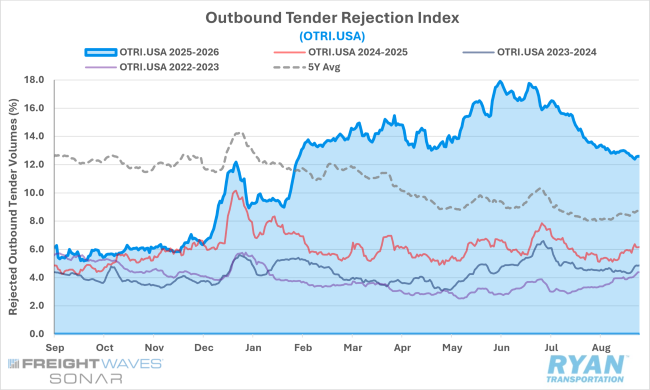
- Outbound tender rejections continued to contract sharply for the second consecutive month in August, falling 241 bps MoM and marking the largest monthly decline since April 2022.
- Despite the sharp declines, rejection rates remain well above year-ago levels, registering 7.4% higher YoY than in August 2025.
Morgan Stanley Truckload Freight Index
Key Points
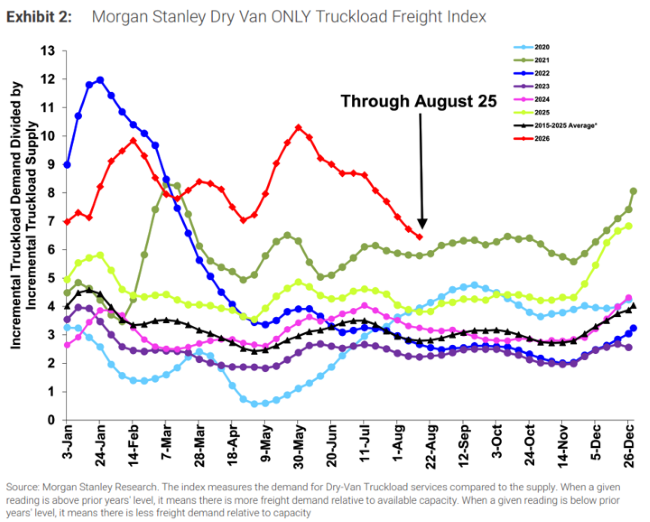
- The Morgan Stanley Truckload Freight Index continued to decline sequentially throughout August and underperformed normal seasonality, driven by weakness in both the supply and demand components.
- According to the MSTLFI report, both the reefer and flatbed indices decreased sequentially but were in line with typical seasonality.
Truck Transportation Payroll Employment
Key Points
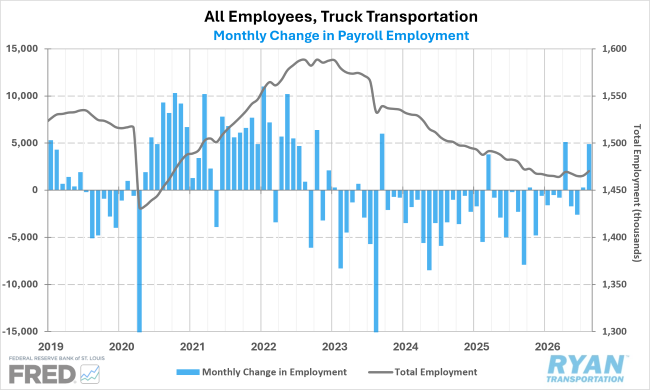
- For-hire trucking employment added 4,800 jobs on a seasonally adjusted basis in August following slight upward revisions to June and July estimates that added 400 jobs, according to the latest employment report by the Bureau of Labor Statistics (BLS).
- August’s monthly gains in truckload employment mark the largest increase since 5,100 jobs were added in March and are just the third month in 2026 to register an increase after 400 new jobs were added in July.
Preliminary North American Class 8 Tractor Net Orders
Key Points
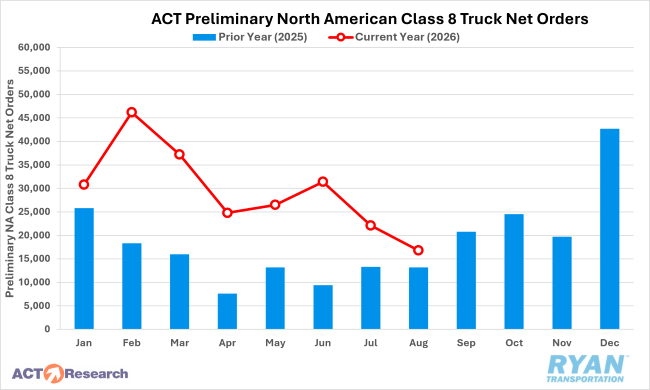
- Preliminary North American Class 8 truck orders cooled further in August as the 2026 order season came to an end with estimates ranging between 16,800 and 18,200 per ACT Research and FTR, marking a decline of 24% and 19% MoM, respectively, while annual comparisons remain elevated by 27% and 43% YoY, respectively.
- According to both research outlets, the further declines are not indicative of weak demand but can be attributed to typical summer seasonality and the limited number of available build slots, with some OEMs reportedly running out of 2026 order slots by mid-August.
- FTR expects September to provide a more accurate picture of true equipment demand as the EPA’s 2027 NOx Compliance rule is set to take effect forcing carriers to decide how to navigate between noncompliance penalties on current-generation engines, which could cost between $6,000-7,000 per engine, or OEM upcharges for fully compliant 2027 engines, which are expected to range between $8,000 and $12,000 per unit.
FTR Active Truck Utilization
Key Points
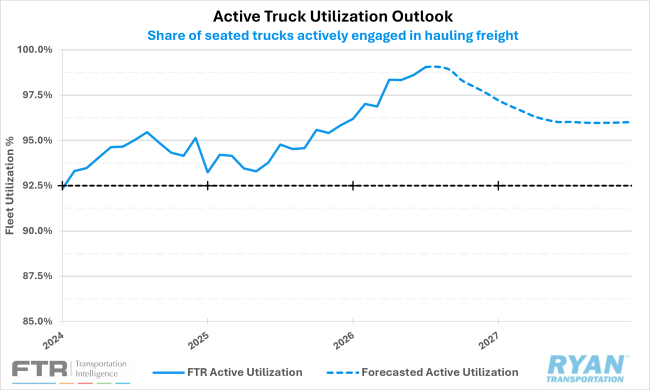
- FTR’s forecast for active truck utilization strengthened further for Q3 2026, now expected to reach 99.0% from the previous outlook of 98.4%, while expectations for Q4 have held steady at around 98%.
- Further sluggishness in employment, despite robust freight rates, raises the question of whether carriers are finding it harder to add drivers due to, among other things, intense pressure on foreign drivers over the past year, with active utilization levels forecast to stabilize at 96% by Q2 2027.
Outlook
Truckload capacity is expected to remain relatively tight through the remainder of 2026, though seasonal fluctuations could create temporary relief for shippers. Industry forecasts continue to point to ongoing regulatory enforcement, limited fleet expansion, uncertainty around carrier availability and higher insurance premiums as the primary headwinds restricting the pace of capacity growth. At the same time, strong intermodal demand and shifting freight patterns may help absorb some transportation demand that would otherwise move via truckload, potentially leading to softer utilization levels.