Back to October 2026 Industry Update
October 2026 Industry Update: Truckload Supply
Main Takeaways
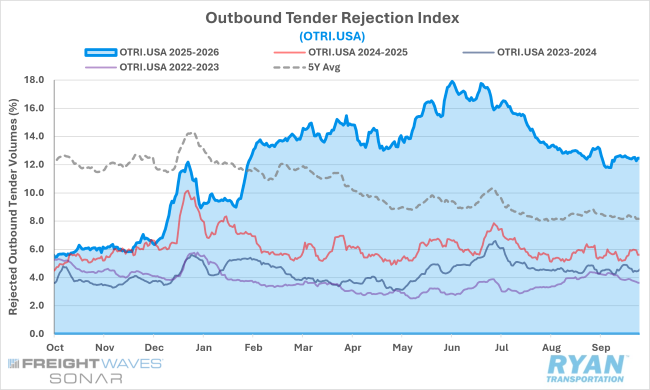
- Truckload capacity loosened throughout August as tender rejection rates declined, but market conditions remained significantly tighter than historical norms.
- Carrier utilization remained elevated and available capacity stayed constrained, continuing to support a carrier-favorable market despite recent easing trends.
Summary
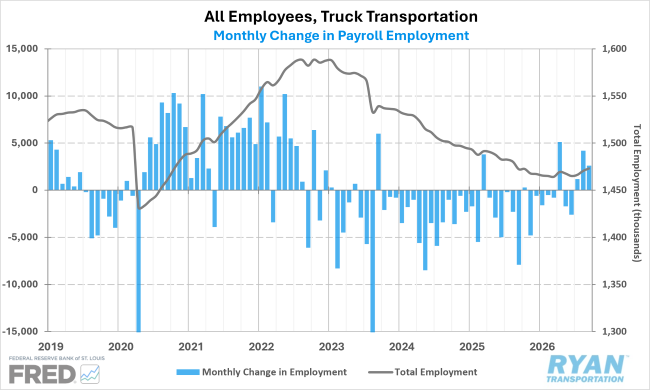
Labor Day-related disruptions had short-lived effects on rejection rates, as capacity conditions continued to ease from their summer highs. However, despite declining rejection rates, market conditions remained significantly tighter than historical norms, with active utilization near 99%. While trucking employment increased from August levels, payrolls remained below year-ago figures as elevated equipment and financing costs, combined with rising fuel prices, continued to push carriers to prioritize equipment replacement over meaningful fleet expansion.
SONAR Outbound Tender Rejection Index (OTRI.USA)
Key Points
- Outbound tender rejections were mostly stable in September after some volatility in the first two weeks, with the run-up to Labor Day weekend in the first week followed by the post-holiday lull in activity in the second, resulting in average rejection rates dropping slightly MoM by 49 basis points.
- Despite marking the third consecutive month of declines, rejection rates are still 6.9% higher YoY and up nearly 8% on a 2-year stack.
Morgan Stanley Truckload Freight Index
Key Points
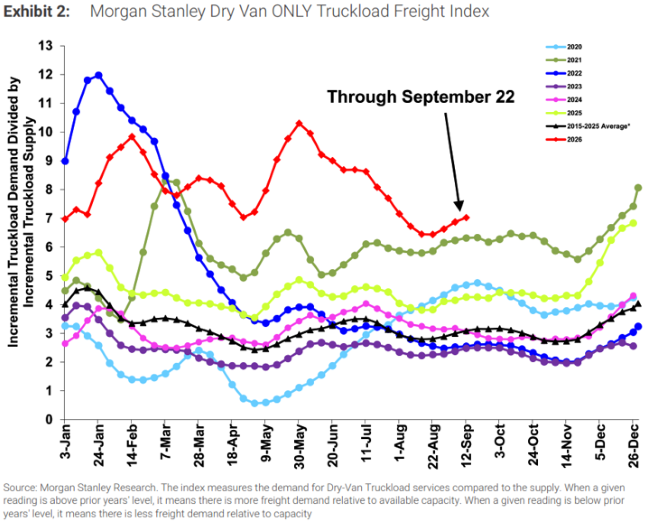
- After declining steadily since May, the Morgan Stanley Truckload Freight Index turned positive and rose sequentially throughout September, in line with seasonality in the first half of the month, before slightly underperforming in the second half.
- According to the MSTFLI report, the outperformance of the demand component relative to seasonality throughout the month was offset by a stronger underperformance in the supply component in September.
- Both the Reefer and Flatbed Indices registered sequential increases throughout the month; however, the performance versus typical seasonality was mixed, as the Reefer Index underperformed, while the Flatbed Index outperformed.
Truck Transportation Payroll Employment
Key Points
- For-hire trucking employment added 2,600 jobs on a seasonally adjusted basis in September, marking the third consecutive month of gains and the first time since August 2022 that truckload employment added seasonally adjusted jobs for three straight months.
- Revisions to preliminary estimates for July and August resulted in a net increase of 200 jobs, with 1,200 added in July and 4,200 in August.
- Three consecutive months of payroll gains led to annual comparisons registering 0.1% higher YoY than September 2025 employment levels, the first positive prior-year comparison since April 2023.
Preliminary North American Class 8 Tractor Net Orders
Key Points
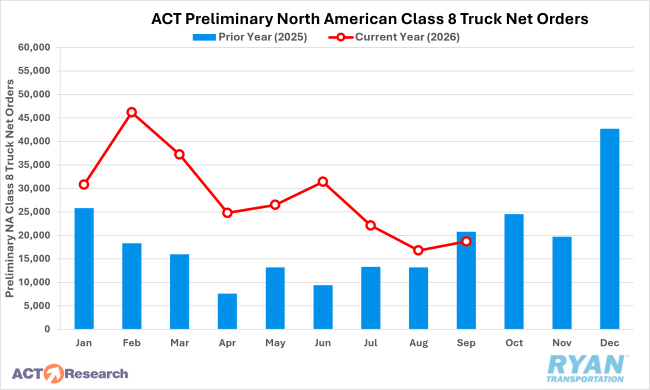
- Preliminary North American Class 8 truck orders slowed further in September, with estimates ranging between 18,700 and 21,300 units per ACT Research and FTR, marking an increase of 11.3% and 17.5% MoM, respectively. Annual comparisons appear mixed, with ACT Research reporting a 9.5% YoY decline and FTR reporting an increase of just over 3% YoY.
- According to the reports, despite underlying demand remaining robust, the weakness in September’s order levels stemmed from OEMs not fully opening their 2027 order books and from uncertainty surrounding emissions regulations, as the EPA recently proposed changes to its 2027 heavy-duty engine rule to ease warranty requirements that were set to increase costs and impact products.
FTR Active Truck Utilization
Key Points
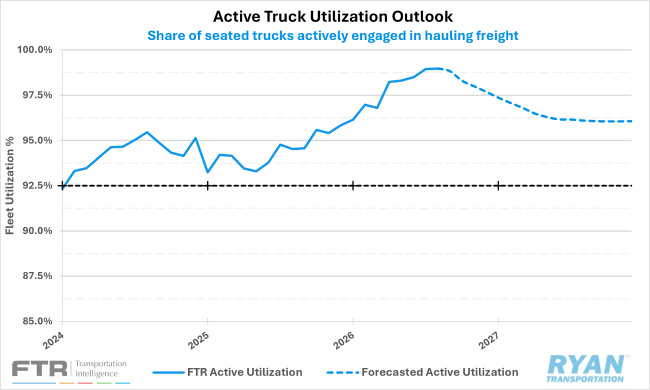
- FTR’s forecast for active truck utilization remained relatively stable for Q3 2026 after a slight downward revision, with utilization expected to peak at 99% before settling at 98% through the fourth quarter.
- According to FTR, the 2027 outlook remained unchanged, with utilization projected to stabilize at 96% by Q2 and remain around that level for the remainder of the year.
Outlook
Capacity conditions should continue to support softer demand levels in the near term but are expected to remain constrained throughout the remainder of the year. Higher truckload rates may encourage some capacity rebuilding and the return of previously sidelined equipment; however, limited driver availability and record diesel prices could slow the pace of any meaningful supply growth. With limited excess capacity, the market remains highly susceptible to volatility from holiday demand surges and winter weather disruptions.