Back to October 2026 Industry Update
October 2026 Industry Update: Truckload Rates
Main Takeaways
- Linehaul rates remained largely stable in September as seasonal demand softened, but all-in transportation costs reached record highs due to surging diesel prices.
- Contract and spot rates continue to hold well above year-ago levels, highlighting the market's elevated pricing floor despite weaker freight demand.
Summary
The steady declines in truckload rates observed in August continued into September as the industry transitions from the summer peak season into the holiday retail shipping season. However, brief rate increases driven by Labor Day disruptions and end-of-quarter shipping activity kept rates largely in line with August levels, though still below their summer peaks. While linehaul prices continued to soften, record-high diesel prices pushed all-in rates higher, driving up total truckload spot and contract rates, including fuel, to all-time highs.
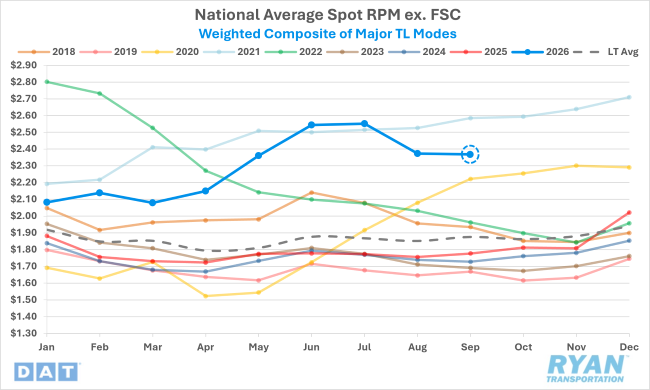
DAT National Average Spot Rates excl. FSC, Weighted Composite Index
Key Points
- After the sharp decline in August, total truckload spot linehaul rates were largely unchanged in September, down just 0.3% MoM (<$0.01).
- Compared to September 2025, total truckload spot rates excluding fuel are up 33.3% YoY ($0.59) and are 25.2% ($0.48) above the long-term average.
- Including fuel, total truckload spot rates rose 4.5% MoM ($0.14) and are $1.04 higher than all-in spot rates in September 2025.
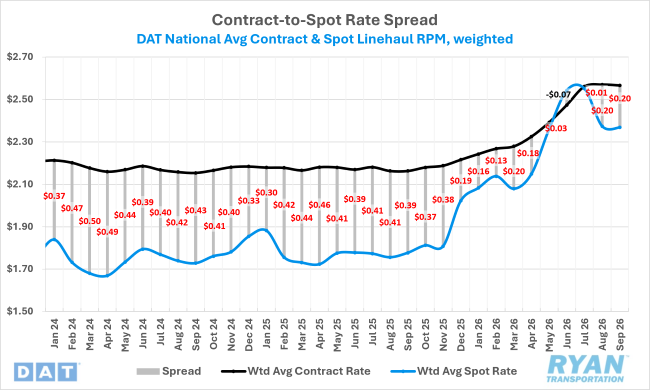
DAT National Average RPM Contract vs. Spot
Key Points
- Initially reported total truckload contract linehaul rates were virtually unchanged in September, down 0.2% MoM (<$0.01) but still 18.6% higher YoY ($0.40).
- The lack of movement in the spot and contract markets kept the contract-to-spot spread unchanged from August, with contract rates continuing to trend at an 8.4% premium relative to spot rates.
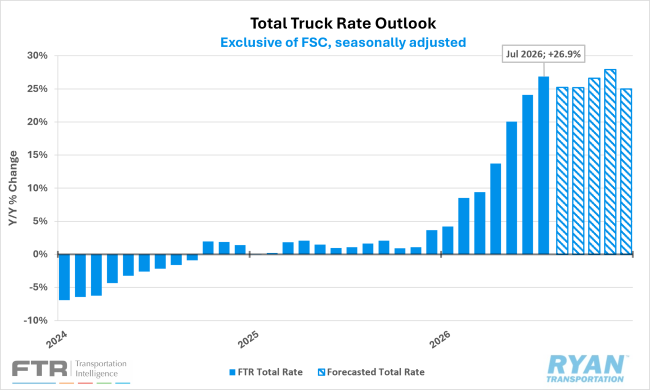
FTR Total Truck Rate & Outlook
Key Points
- After holding steady for the past few months, FTR’s total truckload rate forecast for 2026 rose to +19.7% YoY, up from the previously forecasted +18.3% YoY, as all equipment types registered stronger growth.
- Both total spot and contract rates strengthened in the latest outlook, with total spot rates expected to increase +36.0% YoY in 2026, up two tenths of a point from last month’s forecast, while contract rates are expected to grow +12.0% YoY in 2026, up from +10.0 growth forecasted previously.
- According to FTR, the forecast for total truckload rates in 2027 also strengthened this month, rising to +10.8% YoY from +7.8% previously.
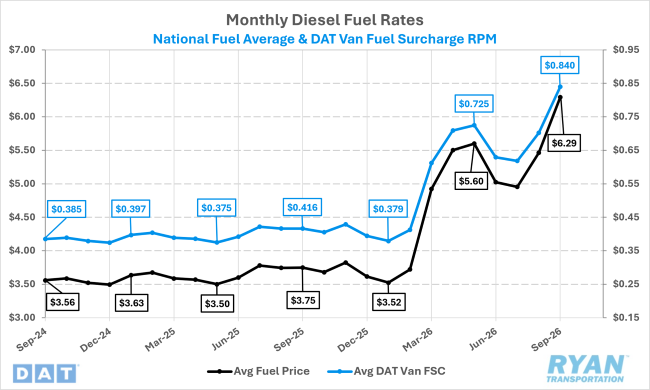
DAT Fuel Trends
Key Points
- Average fuel prices continued to climb in September for the second consecutive month, with the monthly average diesel price spiking $0.83 MoM to $6.29/gallon and putting diesel prices $2.54/gallon above September 2025 levels.
- The rise in diesel prices was the biggest headline in September, as the four highest prices ever recorded since the Department of Energy (DOE)/Energy Information Administration (EIA) began tracking prices in 1994 occurred between September 7 and September 28, with the highest occurring September 21, when the national average reached $6.529/gallon.
- The EIA revised its pricing outlook up from last month, with 2026 retail diesel prices expected to average $5.19/gallon, up 2.4% from the previous forecast, while the 2027 outlook increased 2.0% from an average of $4.40/gallon to $4.49/gallon.
Outlook
Looking ahead, linehaul rates are likely to remain relatively stable in the near term ahead of the holiday retail shipping season, unless significant external shocks occur. However, pricing pressure is expected to persist because of fuel market volatility, particularly as colder weather increases heating oil demand and further strains already tight distillate inventories. With overall freight demand indicators remaining weak and capacity conditions continuing to tighten, any sharp increases in truckload rates throughout Q4 are likely to be concentrated around key markets and peak shipping windows rather than broad-based across the network.