Back to November 2026 Industry Update
November 2026 Industry Update: Truckload Supply
Main Takeaways
- Truckload capacity remained constrained in October, with tender rejection rates continuing to run above both prior-year levels and historical averages despite easing from summer highs.
- Signs of a meaningful capacity recovery remained limited as for-hire trucking employment stagnated and fleet expansion activity remained subdued.
Summary
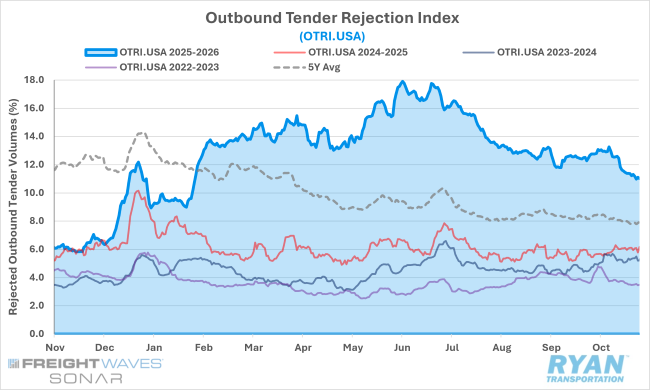
Following a brief increase in the first half of the month, tender rejections retreated through the back half of October, finishing the month slightly below where they began. Despite the moderation and continued easing from their summer peaks, rejection rates remained elevated relative to historical norms, reflecting a truckload market that is still materially tighter than in previous cycles. Signs of a meaningful supply recovery have also yet to emerge, as for-hire trucking employment was unchanged in October and has shown only modest growth over the past several months. Likewise, new equipment orders have continued to weaken as regulatory uncertainty and rising cost pressures have made carriers increasingly hesitant to expand fleets.
SONAR Outbound Tender Rejection Index (OTRI.USA)
Key Points
- After climbing 61 bps in the front half of the month to their October peak of 13.27%, outbound tender rejections declined steadily through the remainder of the month, dropping 216 bps to end the month roughly 1.6% below where they started.
- The second-half declines resulted in average tender rejections for the month declining for the fourth straight month, dropping 53 bps MoM.
- Despite the consecutive declines, rejection rates are still up 6.4% YoY and remain 7% higher on a two-year stack.
Morgan Stanley Truckload Freight Index
Key Points
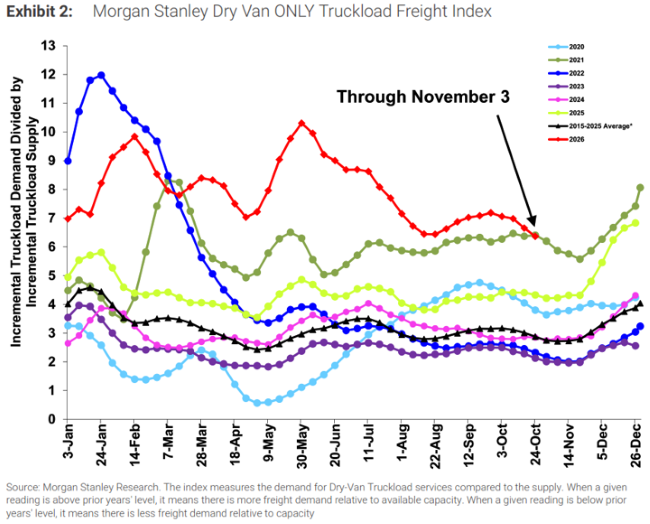
- Following sequential increases throughout September, the Morgan Stanley Truckload Freight Index registered steady sequential declines in October and underperformed typical seasonality.
- According to the report, the underperformance in the headline index was driven entirely by weakness in the demand component, which decreased throughout the month and continued to underperform seasonality, but was partially offset by sequential increases and outperformances in the supply component.
- Both the reefer and flatbed indices also decreased sequentially throughout the month and underperformed typical seasonality in October.
Truck Transportation Payroll Employment
Key Points
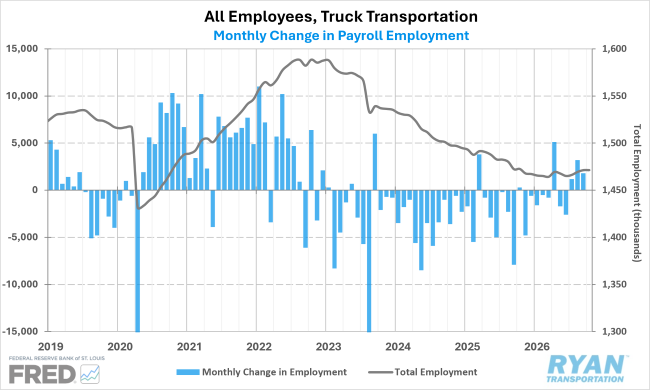
- For-hire trucking employment was unchanged in October, according to preliminary estimates from the Bureau of Labor Statistics (BLS), following downward revisions to both August and September figures totaling 1,800 jobs.
- Current payroll figures are down slightly but essentially flat compared to last year and are down 3.0% compared to the pre-pandemic levels in February 2020, with for-hire trucking job growth showing a marginal net increase of 6,200 jobs over the past four months.
- More granular data available through September reflected a moderate decline in general freight truckload jobs for the first time in seven months, dropping by just 500 jobs.
Preliminary North American Class 8 Tractor Net Orders
Key Points
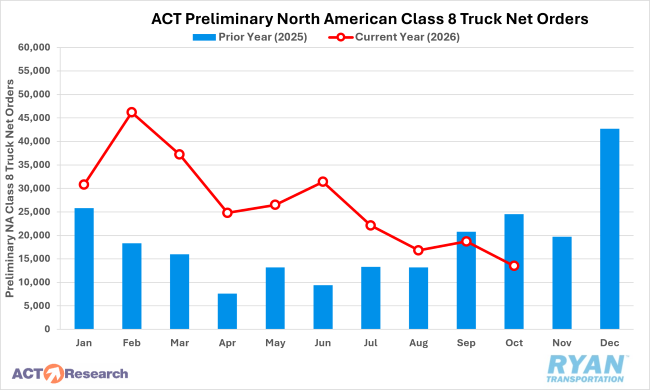
- Preliminary North American Class 8 truck orders fell further in October, with order estimates ranging between 13,500 and 15,600 units as reported by FTR and ACT Research, marking sequential declines of 24% and 28% MoM, respectively.
- Annual comparisons were also notably lower in October, with FTR estimates registering 36% lower YoY compared to October 2025, while ACT Research reported a decline of 45% YoY.
- Both outlets echoed similar sentiment for October’s disappointing figures, with the primary driver continuing to revolve around regulatory uncertainty involving the EPA’s 2027 NOx emissions ruling that is likely delaying MY 2027 truck pricing, production schedules and fleet purchasing decisions.
- The other notable factor limiting equipment demand, according to both firms, stemmed from ongoing margin pressure caused by rising fuel, insurance and labor expenses despite continued support from still-strong spot rate growth.
FTR Active Truck Utilization
Key Points
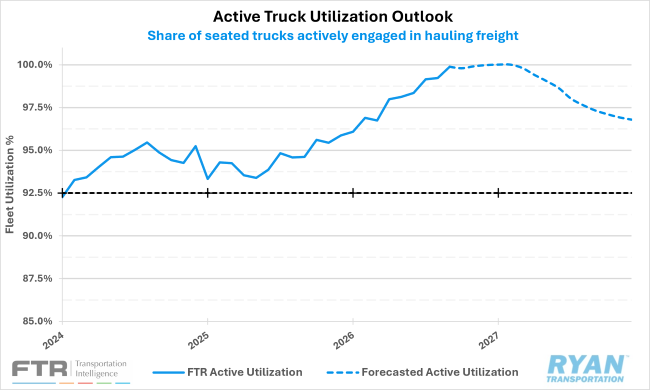
- A combination of a stronger freight forecast, lagging job growth in the trucking sector and continued rate strength pushed FTR’s active truck utilization outlook peak up from roughly 99% to essentially 100%, with no real softening expected through Q1 2027.
- Following the Q1 2027 peak, active truck utilization is expected to normalize throughout the rest of the year. However, the stronger base means the active utilization should exceed prior forecasts by at least a percentage point through late 2027, leveling off around 96% absent any significant changes in the current freight demand or capacity outlooks.
- FTR noted that the recent upward revisions are more conservative given the uncertainty over the true impact of regulatory enforcement pressures, indicating that some upside risks still exist; however, with the recent upward shift, forecast risks are likely more weighted to the downside.
Outlook
Truckload capacity is likely to tighten further through the remainder of Q4 as seasonal demand surges and supply disruptions place additional pressure on an already constrained carrier pool. With little growth in for-hire employment and new equipment orders remaining weak, there is limited evidence that enough incremental supply will enter the market in the near term to materially ease those pressures. This delayed supply recovery is likely to extend into 2027, as barriers to entry remain considerably higher than in prior cycles due to stricter enforcement of English language proficiency and non-domiciled CDL requirements, keeping a large pool of potential drivers from entering the industry. Prolonged elevated diesel prices could further exacerbate tight capacity conditions by compressing carrier margins and forcing smaller operators out of the market. As a result, while seasonality will continue to influence market conditions, the reduced capacity base is likely to amplify the impact of regional disruptions and short-term demand spikes.