Back to November 2026 Industry Update
November 2026 Industry Update: Truckload Rates
Main Takeaways
- Truckload rates continued to strengthen in October as constrained capacity and elevated operating costs supported both spot and contract pricing.
- Higher fuel costs amplified rate inflation during the month, as tighter market conditions allowed carriers to pass rising operating expenses through the market more quickly than in recent years.
Summary
Truckload rates continued to strengthen in the early weeks of October as momentum from the strong end-of-quarter push late in September kept capacity levels constrained to start the month. Although conditions had largely normalized by mid-month, regional pocks of tight capacity continued to place added pressure on national rates and deviating from typical seasonal patterns. In the contract market, rates continued to firm as carriers increasingly deferred on contractual obligations to seek out higher-yielding spot volumes, leaving gaps across routing guides. Additionally, elevated fuel prices continued having an outsized influence on truckload rates, as tighter capacity conditions has enabled carriers, particularly those operating primarily in the spot market, to pass through a portion of the rising input costs more quickly than would be expected under balanced market conditions.
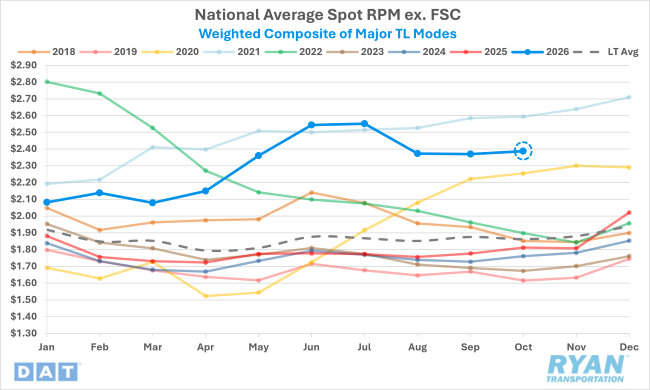
DAT National Average Spot Rates excl. FSC, Weighted Composite Index
Key Points
- Total truckload spot linehaul rates increased slightly in October following two months of declines, rising 0.8% MoM ($0.02).
- On an annual basis, total truckload spot rates excluding fuel remain 31.8% higher YoY ($0.58) and are 2.6% ($0.50) above the long-term average.
- When inclusive of fuel, total all-in truckload spot rates increased 0.4% MoM ($0.01) and are up 45.9% YoY ($1.03) compared to October 2025.
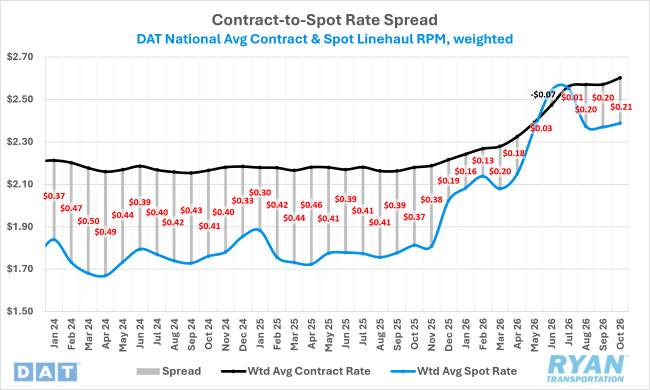
DAT National Average RPM Contract vs. Spot
Key Points
- Initially reported total truckload contract linehaul rates increased 1.2% MoM ($0.03) in October and are 19.4% higher YoY ($0.42).
- Similar movements across spot and contract rates kept the contract rate premium just over 8% in October and virtually unchanged from August and September.
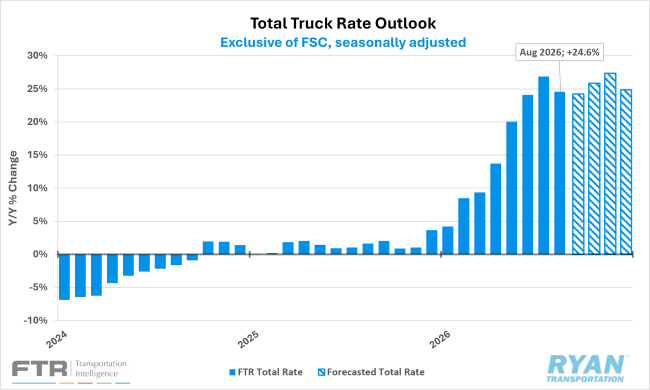
FTR Total Truck Rate & Outlook
Key Points
- FTR’s total truckload rate forecast for 2026 eased slightly to +19.5% YoY growth in October, down from the previously reported +19.7% YoY, while the 2027 outlook strengthened to +11.7% YoY growth, up from +10.1% previously.
- According to FTR’s reporting, the softening in the 2026 outlook stemmed from a drop in spot rate growth to +35.2% YoY from +36.0% in the previous outlook, while contract rates strengthened a tenth of a point to +12.1% YoY.
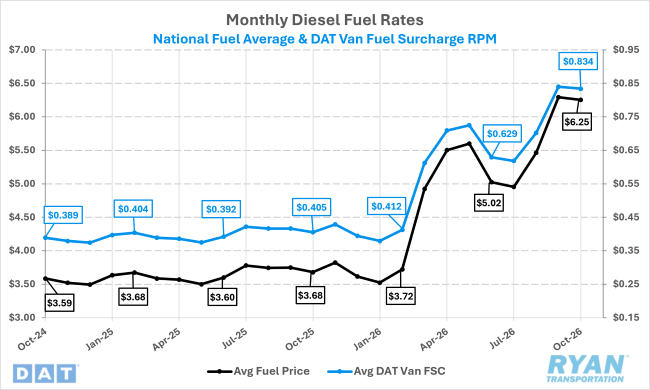
DAT Fuel Trends
Key Points
- Average fuel prices weakened moderately in October after considerable gains in August and September, with the monthly average diesel price declining $0.04 MoM to $6.25/gallon, bringing diesel prices $2.57/gallon above October 2025 levels.
- After opening the month sharply lower from their record peak a few weeks earlier in September, benchmark retail diesel prices rebounded late in October to close out the month at $6.352/gal and the third-highest price on record, following reports that a peace deal between Iran and the U.S. remained well out of reach.
- In In its latest Short-Term Energy Outlook (STEO), the Energy Information Administration (EIA) revised its average retail diesel price higher from last month, with 2026 prices now expected to average $5.25/gal, up 1.2% from the previous outlook of $5.19/gal, while 2027 prices are forecasted to average $5.03/gal, a 12% increase from the previously reported $4.49/gal.
Outlook
Looking ahead, truckload pricing should continue to trend higher through the final two months of the year, with holiday demand and capacity disruptions set to reintroduce substantial volatility back into the market. Near-term rate growth expectations are up slightly as the late September surge led to truckload prices entering Q4 at a higher baseline. Conditions are expected to remain relatively stable through the front half of November before tightening in the second half ahead of Thanksgiving and continuing through December. However, as truckload supply remains constrained, the length and level of relief from that stability may be limited. Elevated diesel prices will also continue to have considerable influence on rates in the coming months, both directly as carriers attempt to pass through costs more quickly, and indirectly by squeezing margins, forcing smaller operators out and reducing the pool of available trucks.