Back to November 2026 Industry Update
November 2026 Industry Update: Truckload Demand
Main Takeaways
- Truckload demand softened in October as freight volumes retreated from the elevated levels observed during the end-of-quarter shipping surge in September.
- U.S. containerized imports reached record levels, while retail inventory stocking efforts have ramped up but have yet to translate into meaningful truckload volumes.
Summary
Truckload demand continued to soften modestly in October, as contracted tender volumes declined for a fourth consecutive month and spot market activity pulled back following September’s rebound. The weakness in truckload came despite broader signs of improvement across the freight network, including record import volumes and increased inventory building as retailers moved goods downstream ahead of the Q4 holiday season. The lack of a more meaningful pickup in over-the-road volumes against this backdrop suggests that a larger share of freight may be shifting toward rail and intermodal, particularly on longer-haul lanes. Elevated inventory carrying costs are also likely reinforcing that shift, as shippers look to take advantage of lower transportation costs and can better absorb longer transit times while replenishing inventory ahead of peak season.
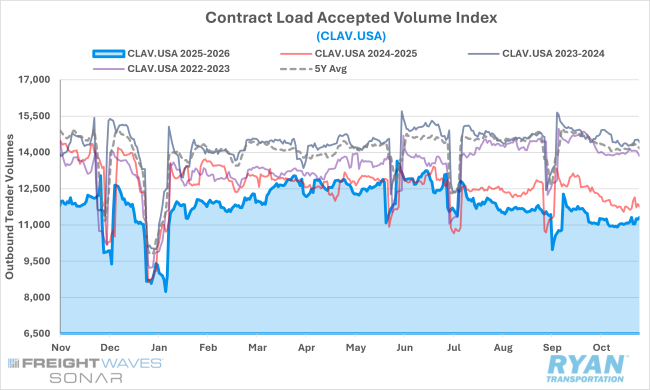
SONAR Contract Load Accepted Volumes Index (CLAV.USA)
Key Points
- Average tender volumes accepted under contract continued to soften in October, dropping 2.5% MoM and marking the fourth consecutive month of declines.
- The ongoing weakness in demand and steady monthly declines kept contracted volumes trending below year-ago levels, with the CLAV index registering 7.1% lower YoY and 23.7% lower on a two-year stack.
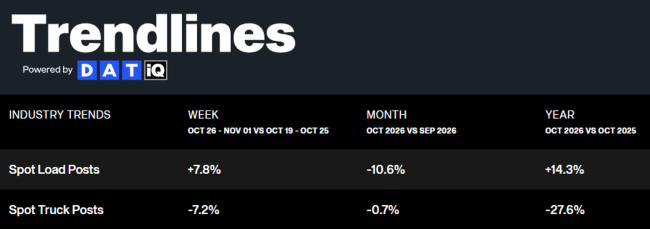
DAT Trendlines
Key Points
- After rebounding in September, spot market activity declined in October but has remained above year-ago levels for 19 straight months.
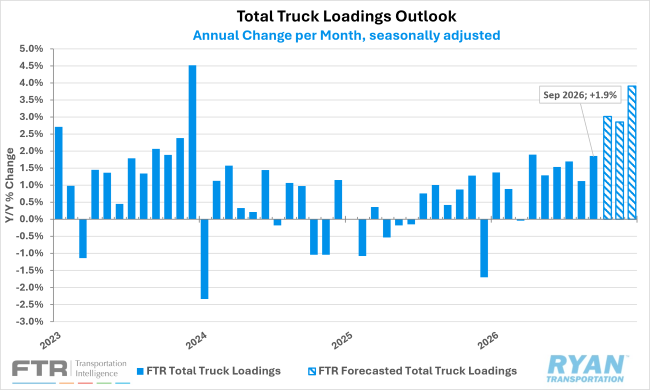
FTR Total Truck Loadings Outlook
Key Points
- FTR’s total truck loadings outlook for 2026 improved moderately in the latest release, rising to +1.8% YoY growth from +1.6% previously, driven by strength in refrigerated volumes.
- All major equipment types saw upward revisions to their 2026 loadings outlook, with the refrigerated sector registering the most notable gains, rising from +1.7% YoY to +2.1%, followed by an increase of a tenth of a point for both of the dry van and flatbed forecasts to +1.9% YoY and +4.5% YoY, respectively.
- FTR’s forecast for 2027 total truck loadings was also broadly improved, driven by stronger expectations for food, aggregates and chemical volumes, with the outlook rising from +1.9% YoY previously to +2.4%.
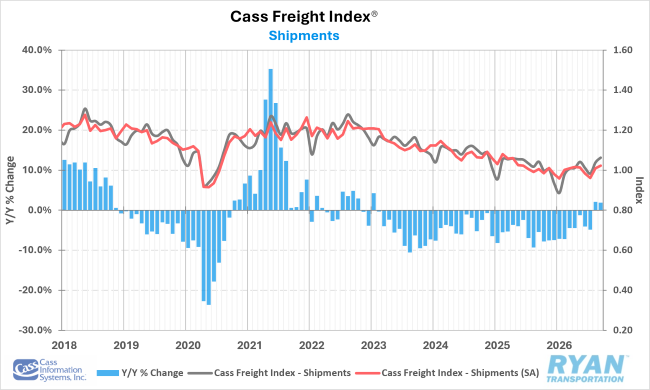
Cass Freight Index Shipments Forecast – September 2026
Key Points
- The shipments component of the Cass Freight Index rose 2.3% MoM in September and was up 1.9% YoY, marking the second straight annual gain after 3.5 years of declines, the longest streak on record for this measure.
- In seasonally adjusted terms, shipments were up sequentially by 1.4% MoM following a 5.0% gain in August.
- According to the latest Cass Report, modest retail and industrial growth, along with inventory restocking as imports surge, are positive tailwinds for a recovery in freight demand, with normal seasonal patterns suggesting the shipment components of the index should increase 4% YoY in October.
LMI® AT A GLANCE
Key Points
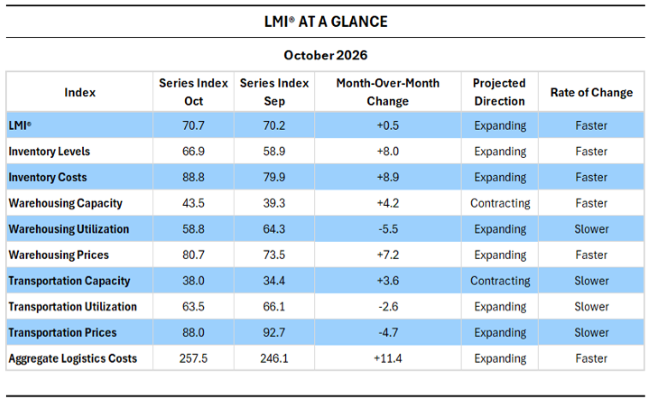
- The October 2026 LMI® read in at 70.7, up (+0.5) from September’s reading of 70.2 and the second-highest reading in four years, just behind June’s reading of 71.1.
- Inventory Levels continued expanding at a robust rate in October; however, unlike last month, the recent growth was driven by downstream retailers building up inventories faster than their upstream counterparts, suggesting the upward movement is a result of retailers stocking up for holiday sales.
- With the further surge in inventory stocks, Inventory Costs have risen to their highest level since March 2022 and put a premium on available storage space, driving up Warehousing Prices as well, resulting in the Aggregate Logistics Cost metric reading in at 257.5, the fastest rate of expansion since March 2022 and a potential foreshadowing of continued supply-driven inflation.
Descartes U.S. Container Import Volumes
Key Points
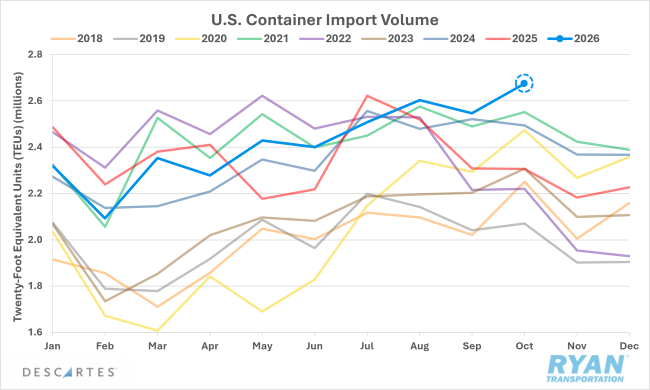
- U.S. containerized imports surged in October, rising 5.0% MoM from September to 2,674,808 twenty-foot equivalent units (TEUs), marking the highest monthly volume on record, exceeding the previous high set in May 2022 by 2%.
- Compared to October 2025 levels, imports last month were up 16.0% YoY, bringing MTD imports up 2.3% YoY compared to the same period last year.
- Imports originating from China rose for a fourth straight month in October, rising 6.9% MoM from September and reaching the highest monthly volume since January 2025.
Drewry World Container Index
Key Points
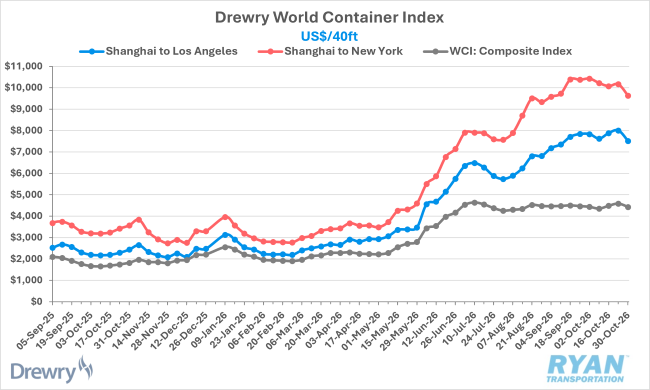
- The WCI composite index ended the month essentially flat in October, dropping 0.1% MoM from the end of September but remains well above year-ago levels, registering 143.2% higher compared to the same time in 2025.
- Weakness in the Transpacific trade routes muted global container rate performance in October, as Shanghai to Los Angeles dropped 4.1% MoM to $7,514/FEU (forty-foot equivalent unit), down from $7,835/FEU at the end of September. Similarly, rates from Shanghai to New York registered 7.6% lower MoM, falling from $10,428/FEU at the end of September to $9,631/FEU in October.
- On a weekly basis, container rates moderated in October as declines in the first week from sluggish volumes caused by China’s Golden Week were offset over the next two weeks as carriers managed capacity, before dropping sharply in the final week because of weak U.S. import demand.
Outlook
Near-term truckload demand should improve modestly through the remainder of Q4 as holiday restocking and year-end shipping activity provide a seasonal lift. However, rising storage and logistics costs, combined with elevated over-the-road rates and fuel prices, continue to strengthen the cost and transit-time advantages of rail and intermodal, creating the potential for further erosion in truckload market share. Beyond these seasonally driven gains, underlying volume growth is likely to remain relatively subdued. Looking into 2027, longer-term forecasts remain mixed, with upside potential tied to continued domestic manufacturing expansion, strong AI-related investment and resilient consumer activity, while persistent inflation and tighter monetary policy remain the primary downside risks.