Back to November 2026 Industry Update
November 2026 Industry Update: U.S. Economy
Main Takeaways
- Economic growth remained supported by resilient consumer spending, continued manufacturing expansion and strong AI-related investment despite mounting inflationary and policy-related risks.
- Residential construction remains a notable area of weakness, as elevated mortgage rates and housing affordability challenges continue to suppress homebuilding activity despite broader economic resilience.
- While economic fundamentals remain healthy, persistent inflation, elevated interest rates and geopolitical and trade-related uncertainty continue to pose risks to the pace of growth heading into 2027.
Summary
The overall economy continues to expand at a solid pace in October, supported by generally positive economic data, though downside risks are rising. Preliminary estimates show U.S. GDP grew 3.4% in Q3 2026, supported by strong consumer spending and surging AI-led business investment. Meanwhile. robust import activity weighed on growth as net international trade represented a significant 3.3 percentage point drag in the GDP calculation. Additional tailwinds stemmed from a rebound in the labor market, with payroll gains exceeding expectations, the unemployment rate edging slightly lower and further expansion in domestic manufacturing the tenth consecutive month. Despite these positives indicators, persistent inflation, elevated interest rates and ongoing geopolitical and trade-related uncertainties have further weighed on household budgets as discretionary spending softened across most categories and buying behaviors shift towards being more value-conscious. Additionally, residential construction data remains near historic lows after weakening significantly in September.
United States ISM Manufacturing PMI
Key Points
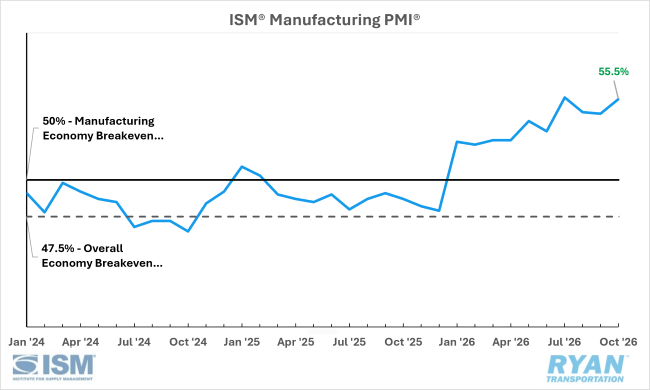
- Domestic manufacturing activity remained relatively steady and continued to expand in October at a slightly faster pace, with the ISM® Manufacturing PMI® registering 55.5%, up 1 percentage point from September’s reading of 54.5%.
- Five of the six largest manufacturing industries expanded in October: Machinery; Computer & Electronic Products; Transportation Equipment; Chemical Products; and Food, Beverage & Tobacco Products.
- In the manufacturing economy, 6% of the sector’s gross domestic product (GDP) contracted in October, compared to 2% in September, while 6% of manufacturing GDP was in strong contraction, compared to 2% in September.
Manufacturing at a Glance
Key Points
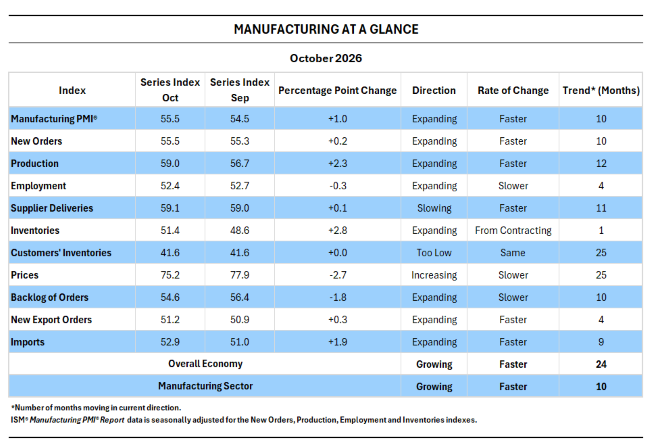
- All five of the main subindexes that directly factor into the Manufacturing PMI® expanded in October, with four (New Orders, Production, Supplier Deliveries and Inventories) growing faster than the previous month, while Employment growth slowed, though only declining by 0.3 percentage points.
- Three of the four demand indicators (New Orders, Backlog of Orders and New Export Orders) remained in expansion in October, while the Customers’ Inventories index remained in “too low” territory, contracting at the same rate as last month but remaining a positive for future production.
- Output indicators, as measured by the Production and Employment indexes, remained positive in October and combined for a 0.4 combined net increase in the PMI® calculation, driven by 12 straight months of expansion in Production while the Employment Index remained in expansion but at a slightly slower rate compared to September.
- Inputs remained mixed, with the Supplier Deliveries Index increasing 0.1 percentage points, the Inventories Index returning to expansion territory following a 2.8 percentage-point increase and the Prices Index decreasing 2.7 percentage points but remaining historically high.
New Residential Construction
Key Points
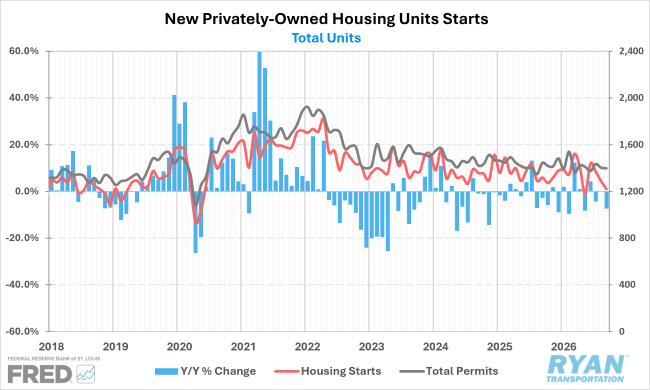
- Housing data was overwhelmingly weaker in September, with housing starts registering monthly declines for the third consecutive month and dropping 5.2% MoM on a seasonally adjusted basis, marking the first three-month consecutive decline since May through July 2024.
- Annual comparisons were also notably weaker, with YoY starts down 7.4% and seasonally adjusted annualized starts reaching their second-lowest level of 1.22 million since May 2020, barely above the 1.18 million annualized starts recorded in May this year.
- Broken down by dwelling type, single-family home starts declined 4.6% MoM in September but remain 2.6% higher YoY compared to September 2025, while starts for multi-family buildings of five or more units fell 7.2% MoM and were down 25.9% YoY.
- Permits authorized for future home construction also declined, but only by 0.2% MoM and were down 3.2% YoY, as single-family build permits dropped 3.9% MoM and were 4.7% lower YoY, while multi-family permits were the long bright spot, rising 5.5% MoM and registering 0.6% higher compared to September 2025.
Bank of America Consumer Checkpoint, Total Card Spending
Key Points
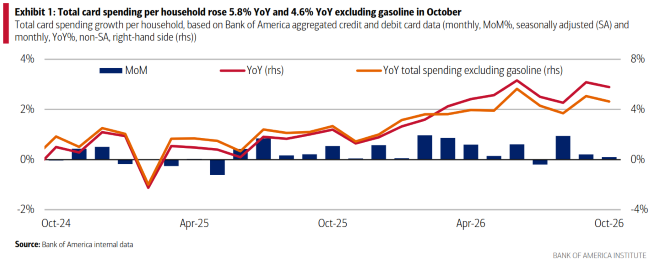
- Seasonally adjusted consumer spending remained solid in October, despite moderating from September, with total card spending per household rising 5.8% YoY, while spending excluding gasoline increased 4.6% YoY, according to Bank of America’s internal spending data.
- Monthly spending growth remained much more muted, rising just 0.1% MoM on a seasonally adjusted basis both with and without gasoline, suggesting momentum remains positive.
- Services continue to represent the majority of overall spending growth, contributing 2.5 percentage points (ppt) in October, down slightly from 2.7 ppt in September, while retail contributed 1.2 ppt for the month, down from 1.6 ppt in September.
Advanced Retail Trade Sales
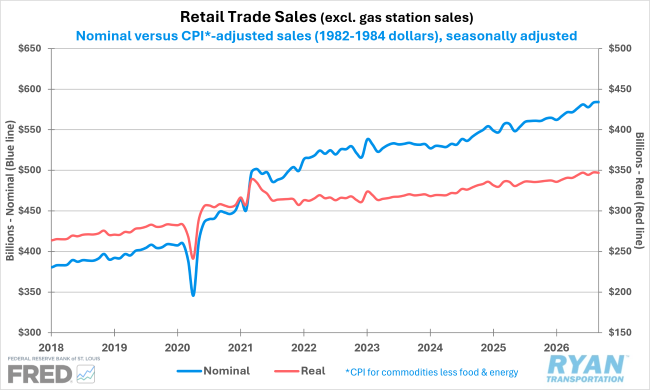
Key Points
- Total retail and food service sales rose 0.8% MoM in September, seasonally adjusted, and were up 6.3% YoY following the Census Bureau’s annual revision of retail sales estimates that significantly reduced overall sales figures since the end of 2022.
- Much like the past few months, September’s figures were largely skewed by the substantial increase in gasoline prices, as total sales excluding gas stations sales, which rose 6.4% MoM, registered a more moderate uptick of 0.2% MoM and were just 4.5% higher YoY.
- Excluding food services, retail trade sales increased 0.7% MoM in September and were up 6.2% YoY; however, when adjusted for inflation, real retail sales were notably weaker, down 0.4% MoM and up just 1.5% YoY.
Outlook
Consumer spending and investment in AI infrastructure are expected to sustain U.S. economic growth in the near term, though the longer-term outlook remains uncertain. Higher energy prices and living costs continue to strain household budgets, while a relatively small group of firms and industries drive an outsized share of overall business investment. Persistent inflation and the recent resilience in the labor market have reinforced expectations for a 25 bps Fed rate increase in December, with the potential for further tightening in early 2027. The AI investment cycle is expected to remain a powerful tailwind for both economic expansion and freight volume support, but the increased reliance on a narrow and capital-intensive source of growth leaves the economy more vulnerable if financing conditions tighten or investor confidence weakens.