Back to March 2026 Industry Update
March 2026 Industry Update: Truckload Rates
Main Takeaways
- Contracted freight volumes rose slightly in February but remain weak compared to previous years, while spot volumes continue to gain considerable market share.
- U.S. containerized imports declined sharply and fell below 2025 levels but continue to trend in line with typical seasonal patterns.
Summary
Recovery efforts from Winter Storm Fern, combined with additional winter weather-related disruptions across the East Coast and Northeast, led to further appreciation in average spot rates in February. Following the third consecutive increase, spot rates have reached their highest levels since April 2022, with gains in average flatbed and dry van spot rates driving the recent growth trajectory. Continued escalation in spot market pricing is exerting sustained upward pressure on average contract rates, pushing them to their highest level in nearly three years.
Nonetheless, contract rate growth continues to lag the more pronounced increases in spot market rates, thereby narrowing the spread between the two to their lowest level since February 2022.
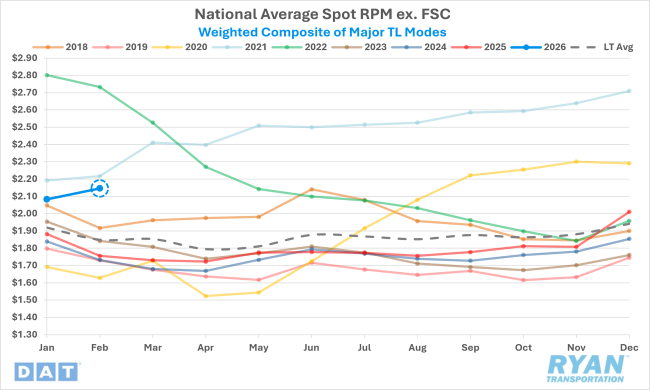
DAT National Average Spot Rates excl. FSC, Weighted Composite Index
Key Points
- Total average linehaul spot rates across all modes increased for the third consecutive month in February, rising 3.2% MoM following gains of 3.6% in January and 11.2% in December. On an annual basis, February spot rates were 22.4% higher YoY, marking the strongest year-over-year comparison since February 2022.
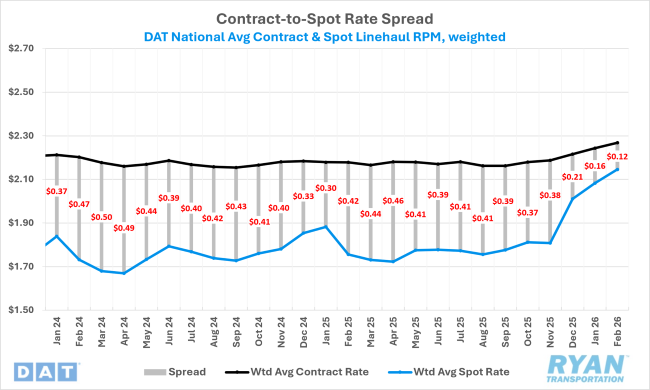
DAT National Average RPM Contract vs. Spot
Key Points
- Initially reported average contract linehaul rates across all modes increased for the fourth consecutive month in February, rising 1.2% MoM and matching January’s gain. The sustained upward trend lifted contract rates 4.2% above February 2025 levels, marking the strongest annual comparison since July 2022. Despite this, continued volatility and strength in the spot market further compressed the contract-to-spot spread, with contract rates averaging just 5.6% above spot levels — down from 7.7% in January and well below the roughly 21% average premium observed throughout 2025.
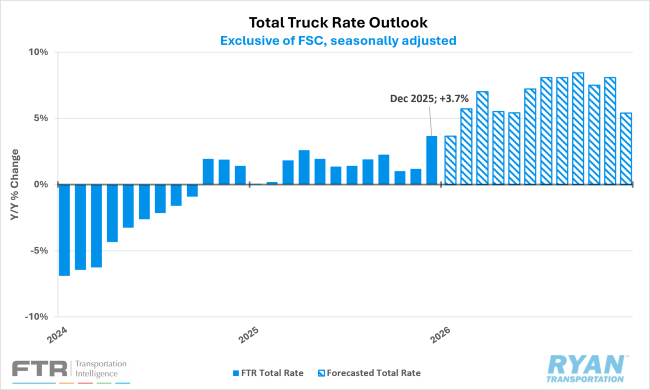
FTR Total Truck Rate & Outlook
Key Points
- In its latest outlook, FTR sharply increased its 2026 total truckload rate forecast to +6.7% YoY from the previously reported +3.7%, driven primarily by a significantly stronger spot rate outlook. Spot truckload rates are now projected to rise +11.5% YoY in 2026, up five percentage points from the prior +6.5% forecast, while the contract rate outlook was revised more modestly to +4.3% YoY growth. By equipment type, flatbed rates saw the largest upward revision, rising to +6.0% YoY, followed by dry van rates, which increased to +6.8%, and refrigerated rates, which rose to +9.0%.
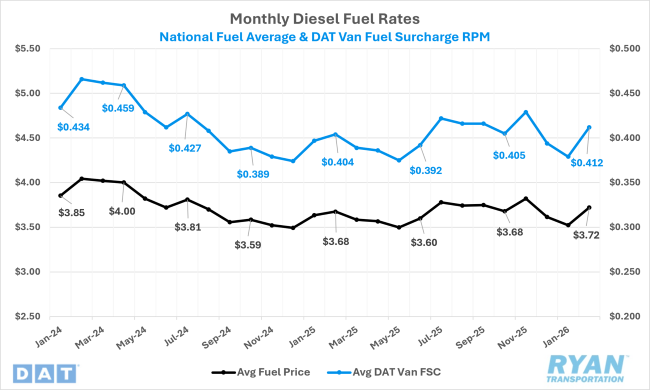
DAT Fuel Trends
Key Points
- Average fuel prices reversed a two-month streak of declines in February, rising sharply by $0.20 MoM and registering a 1.3% YoY increase compared to February 2025 levels, according to the U.S. Energy Information Administration (EIA). In its latest Short-Term Energy Outlook, the EIA modestly revised its 2026 diesel price forecast higher, now projecting a 6.3% YoY decline versus the previous estimate of a 10.7% contraction.
Outlook
Weekly movements in spot rates reflected a normalization trend, retreating through much of the month after a two-week surge of $0.14 in the wake of Winter Storm Fern. As the industry moves into the spring months and the risk of winter-related disruptions fades, rates are expected to track closer to historical seasonal patterns —barring any demand shocks or significant capacity constraints.
However, renewed volatility in oil markets tied to recent U.S. military action involving Iran and the temporary closure of the Strait of Hormuz — through which roughly 20% of global oil supply flows — could place upward pressure on spot rates, which are often quoted on an all-in basis. The extent to which higher energy costs translate into higher freight rates will depend on whether inflationary pressure begins to weigh on demand.