Back to August 2026 Industry Update
August 2026 Industry Update: Truckload Supply
Main Takeaways
- Truckload capacity loosened slightly in July, but carrier availability remains considerably tighter than a year ago as rejection rates and utilization levels stay elevated.
- Limited driver growth and strong Class 8 order backlogs suggest supply expansion will remain constrained through the balance of 2026.
Summary
Truckload supply remained tight in July despite modest loosening following the Fourth of July holiday. Tender rejection rates declined from recent highs, but capacity availability remains constrained as fleet utilization stays elevated and trucking employment has shown little meaningful growth this year. Industry data continues to indicate that carriers are not adding capacity quickly enough to fully meet demand, while transportation capacity readings in the Logistics Managers' Index remain near historically tight levels. Strong Class 8 truck order activity further suggests carriers remain optimistic about future freight conditions even as near-term equipment availability remains limited.
SONAR Outbound Tender Rejection Index (OTRI.USA)
Key Points
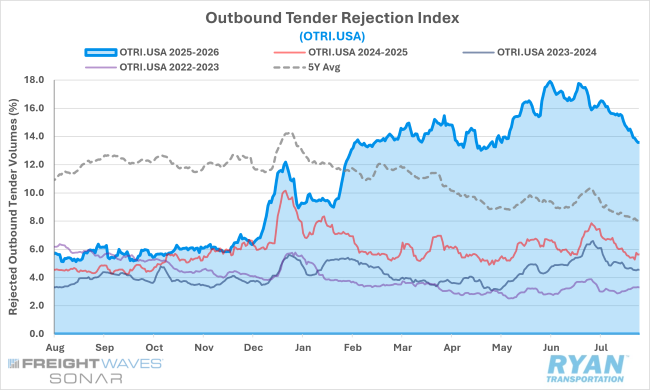
- Following strong gains over the last two months, outbound tender rejections declined sharply in July, falling by 176 bps MoM and marking just the second monthly decline in the last 11 months.
- Despite the notable decline, rejection rates remain well above year-ago levels, registering just over 9% higher YoY than July 2025.
Morgan Stanley Truckload Freight Index
Key Points
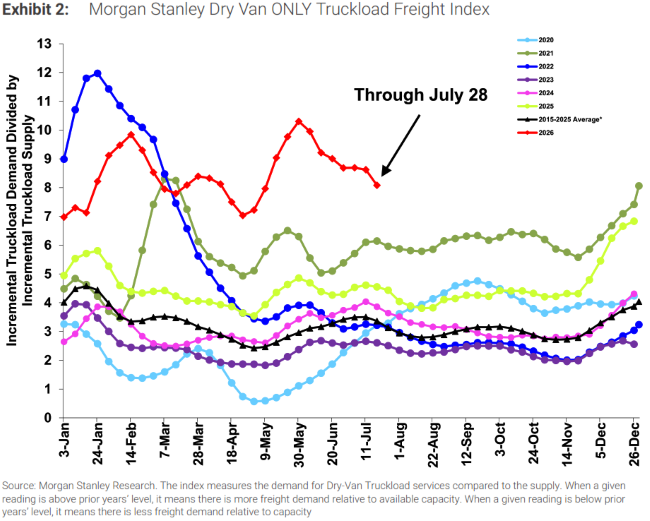
- The Morgan Stanley Truckload Freight Index declined sequentially throughout July and continued to underperform relative to normal seasonality, driven primarily by weakness in the demand component, while supply performed in line with seasonality.
- According to the MSTLFI report, both the reefer and flatbed indices also continued to decrease sequentially throughout July, with the reefer index performing in line with seasonality while the flatbed index continued to underperform.
Truck Transportation Payroll Employment
Key Points
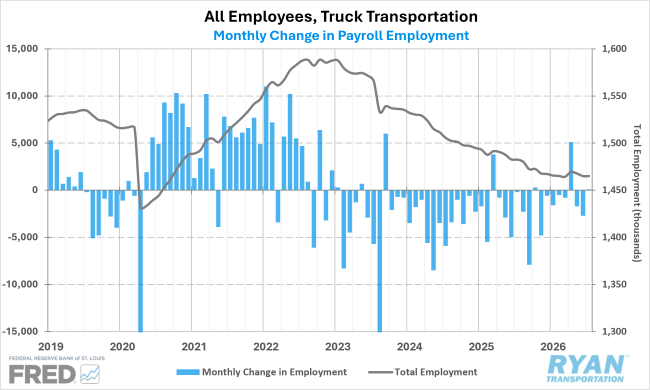
- For-hire trucking employment added just 100 payroll jobs on a seasonally adjusted basis in July following significant downward revisions to May and June, according to the latest employment report released by the Bureau of Labor Statistics (BLS).
- Updated BLS figures for May and June resulted in a net decline of 1,700 jobs in May, 200 more than the previous estimate and a net decline of 2,700 jobs in June, 1,400 more than the previously reported decline of 1,300 jobs.
- Since the end of 2025, trucking has shed 2,100 jobs, with April marking the only single month of strength, adding 5,100 jobs, surrounded by months of declines and no change in July.
Preliminary North American Class 8 Tractor Net Orders
Key Points
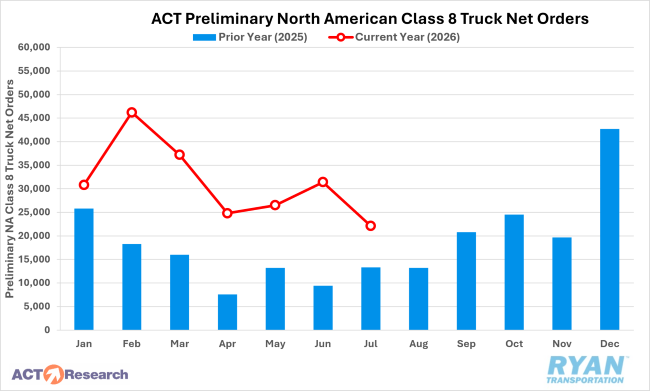
- Despite a sharp contraction from June, preliminary North American Class 8 truck orders remained strong on an annual basis, with FTR and ACT Research reporting estimates ranging from 22,000 to 22,100 units, marking an increase of roughly 66.2% and 75.5% YoY, respectively.
- According to the research outlets, the nearly 30% MoM decline in orders is not a sign of softening equipment demand but rather a shortage of remaining 2026 build slots as manufacturers reach full capacity and delay opening 2027 order books against full Class 8 backlogs.
FTR Active Truck Utilization
Key Points
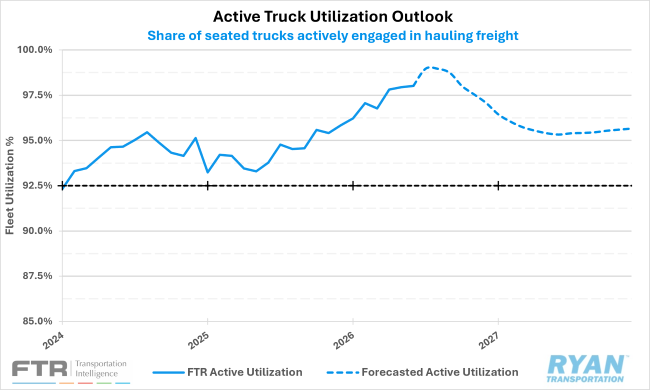
- FTR’s outlook for active utilization in 2026 remained mostly unchanged from the previous forecast in July, with active utilization still expected to peak around 99% in July and August before settling around 96% in Q3 2026.
- According to FTR, indications that trucking firms are not adding drivers as quickly as anticipated led to a stronger 2027 forecast, with the previous outlook revised up by a percentage point through the first half of next year.
Outlook
Capacity conditions are expected to remain relatively tight through the balance of 2026, although seasonal freight softness may provide temporary relief for shippers during late summer. Forecasts for active truck utilization remain near peak levels, and industry analysts continue to cite slower driver additions as a key factor limiting capacity growth. While fleets are placing strong equipment orders, delivery timelines and labor constraints suggest meaningful capacity expansion will take time. As a result, supply conditions are expected to remain supportive of elevated transportation pricing and favorable carrier market conditions into 2027.