Back to August 2026 Industry Update
August 2026 Industry Update: Truckload Rates
Main Takeaways
- Spot rate growth moderated in July, but truckload pricing remains substantially higher than both year-ago and long-term average levels.
- Contract rates continued to strengthen and returned to near parity with spot pricing as shippers readjust routing guides due to tighter market conditions.
Summary
Following the significant gains in May and June, which both rank among the largest month-over-month gains ever recorded, truckload rates remained elevated in July, even as growth momentum began to moderate. Spot rates softened throughout the month following their Fourth of July peak but remain well above levels recorded during the same period last year. Meanwhile, contract rates continued to rise in July as upward pressure from spot rates forced shippers to adjust to tighter market conditions. Additionally, further pricing pressure is being added by the resurgence in diesel prices, as hostilities between the U.S. and Iran resumed in mid-July, with the benchmark retail fuel price registering $0.51 per gallon higher in the final reading of the month compared to the last reading before the fighting restarted.
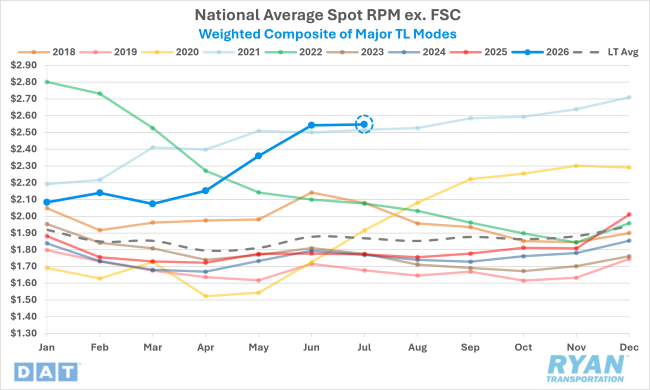
DAT National Average Spot Rates excl. FSC, Weighted Composite Index
Key Points
- Total average truckload spot linehaul rates increased slightly but were largely unchanged, rising by just 0.2% MoM (~$0.01) following an increase of nearly $0.40 over the past two months.
- Compared to July 2025, total truckload spot rates excluding fuel are 43.6% ($0.77) higher YoY and are 35.5% ($0.67) above the long-term average.
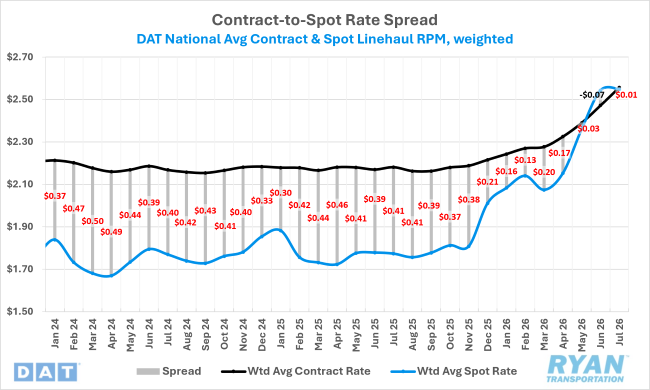
DAT National Average RPM Contract vs. Spot
Key Points
- Initially reported total truckload contract linehaul rates increased 3.4% MoM ($0.09) in July and are up 17.2% YoY ($0.38).
- After inverting in June, the contract-to-spot spread reverted in July, with contract rates trending at a slight 0.4% premium to spot rates.
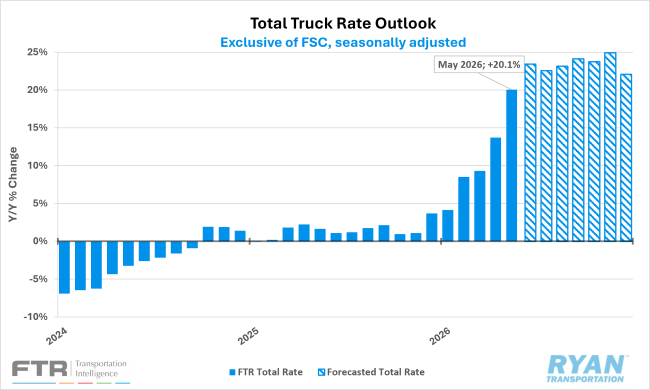
FTR Total Truck Rate & Outlook
Key Points
- FTR’s total truckload rate forecast appears to be stabilizing in July, with the latest outlook remaining virtually unchanged at +18.3% YoY, just a tenth of a point stronger compared to the previous forecast of +18.2%.
- Spot rate growth was slightly stronger in the 2026 outlook, registering +36.1% YoY growth, up 0.8% from the previous projection of +35.3%, while the total truckload contract rate forecast was slightly softer, dropping 0.2% from the previous outlook of +10.1% YoY growth to +9.9% in 2026.
- By equipment type, dry van rate growth saw the only upward revision, with expected growth rising to +18.6% YoY (up from 18.3% previously), while flatbed and refrigerated growth were revised down modestly to +18.3% YoY and +17.3% YoY, down from the previous forecast of +19.3% and 17.9%, respectively.
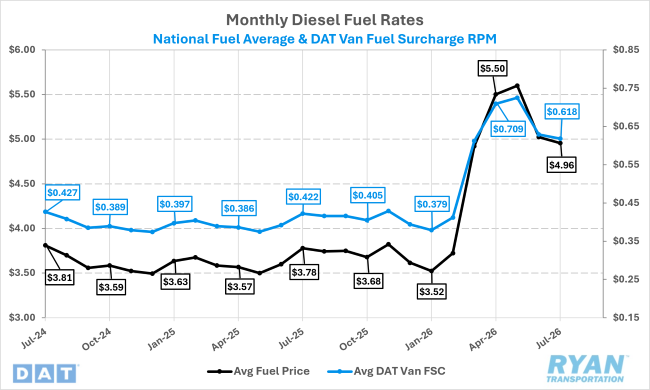
DAT Fuel Trends
Key Points
- The national average monthly diesel price continued to decline in July, down nearly $0.07 MoM from $5.02 in June to $4.96, but remains well above year-ago levels by $1.18.
Outlook
Truckload pricing is expected to remain firm through the second half of 2026 as tight capacity, high equipment utilization and elevated operating costs continue to support carrier rate leverage. While the pace of spot market increases has slowed, current pricing levels suggest the market is transitioning from rapid escalation to a more sustainable period of elevated rates. Contract pricing should continue to trend higher as annual bid activity incorporates current market conditions, helping narrow remaining gaps between contract and spot rates. Barring a significant deterioration in freight demand, truckload rates are likely to remain well above historical averages through year-end.