Back to August 2026 Industry Update
August 2026 Industry Update: U.S. Economy
Main Takeaways
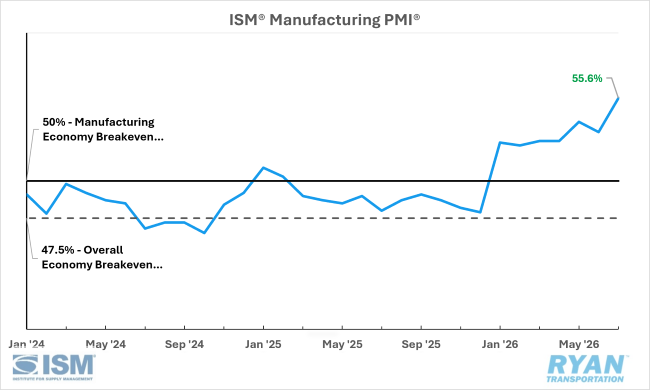
- Manufacturing activity expanded at its fastest pace since 2022, supported by stronger production, new orders, backlogs, exports and hiring activity.
- Housing starts rebounded to their highest levels in nearly a year, though the sector remains weak from a historical perspective.
- Consumer spending softened in July compared to June in the absence of seasonal promotions and World Cup-related activity but remains resilient.
Summary
Economic activity remained resilient through July as manufacturing growth accelerated to its strongest pace in more than four years, while consumer spending continued to advance despite persistent inflationary pressures. Industrial activity has broadened considerably in recent months, with stronger new orders, expanding backlogs, lean inventory levels and widespread gains across freight-related sectors supporting a favorable outlook for goods movement. Business investment continues to be supported by substantial spending on AI infrastructure, data centers and technology capacity expansions. Consumer spending moderated from earlier peaks but remained healthy, supported by stable household finances and continued strength in durable goods purchases. At the same time, businesses continue to navigate higher costs, geopolitical uncertainty, slowing employment growth and a housing market that remains uneven despite isolated areas of improvement.
United States ISM Manufacturing PMI
Key Points
- Domestic manufacturing activity remained in expansion for the seventh consecutive month in July, growing at a faster rate than in June, with the ISM® Manufacturing PMI® registering 55.6%, a 2.3 percentage point increase from June’s reading and the index’s highest level since May 2022.
- Four of the six largest manufacturing industries registered expansion in July in the following order: Transportation Equipment; Machinery; Computer & Electronic Products; and Food, Beverage, & Tobacco Products.
- In the manufacturing economy, 20% of the sector’s gross domestic product (GDP) contracted in July, compared to 5% in June, while no share of the manufacturing GDP was in strong contraction, compared to 3% in June.
Manufacturing at a Glance
Key Points
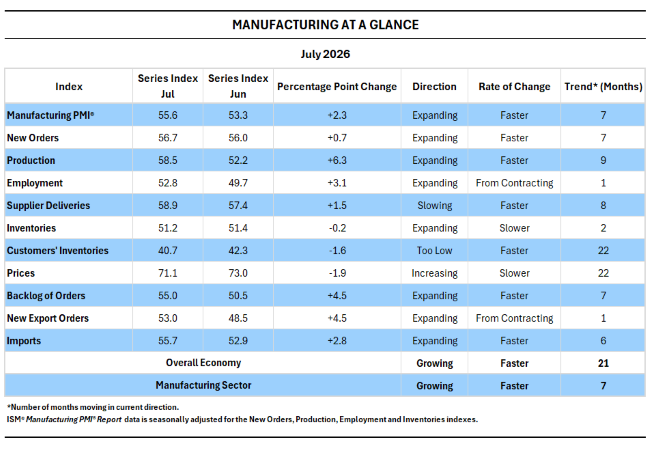
- All five subindexes that factor directly into the Manufacturing PMI® were in expansion territory in July, one more than in June, with four (New Orders, Production, Employment, Supplier Deliveries) growing faster than the previous month.
- Three of the four demand indicators were in expansion territory, and the Customers’ Inventories Index remained in “too low” territory, contracting at a faster rate, a positive for future production.
- Output was also largely positive as the Production Index continued to expand for the ninth consecutive month and the Employment Index entered growth territory for the first time in 33 months. 60% of panelists reported their companies are hiring, while 40% indicated that managing headcounts remains the norm.
- Inputs remained mixed, with the Supplier Deliveries Index rising 1.5 percentage points, the Inventories Index falling 0.2 percentage points but remaining in expansion and relief in the Prices Index continuing for the third straight month.
New Residential Construction
Key Points
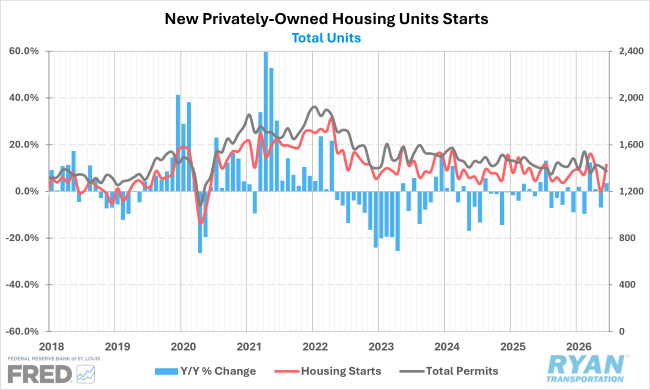
- After falling more than 15% MoM in May, seasonally adjusted housing starts surged by 19% MoM in June, marking the largest MoM increase since May 2023, with the annualized rate of 1.427 million starts slightly trailing the 1.522 million in March but was otherwise the strongest level of new construction since July 2025.
- Starts in multi-family dwellings of five or more units were the primary driver for June’s strength in homes under construction, rising 76.3% MoM in June following a 41% decline in May and were up 19.3% YoY, while single-family home starts dipped 0.2% MoM and are down 3.2% YoY.
- Meanwhile, permits authorized for future construction fell 2.6% MoM and were down 1.8% YoY, with single-family permits driving the weakness, down 2.2% MoM and 0.1% YoY.
Bank of America Consumer Checkpoint, Total Card Spending
Key Points
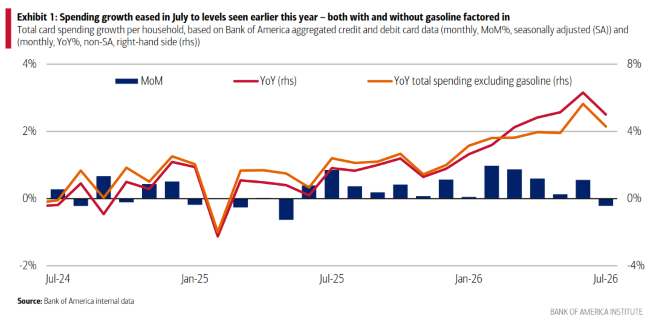
- Seasonally adjusted spending per household eased in July, dropping 0.2% MoM from June and falling to 5.0% YoY growth in July, down from the 6.3% increase recorded in June, according to Bank of America’s internal debit and credit spending data.
- Excluding gasoline, total spending rose 4.3% YoY in July, down from 5.6% in June, with much of the softening likely being tied to fading temporary boosts (i.e., major online promotions and World Cup-related spending) rather than a broad deterioration in underlying demand.
- Spending gaps between income groups continued to converge in July, with lower-income household spending growth rising 5.4% YoY and surpassing high-income household spending growth, while middle-income households lagged slightly, increasing by 4.9% YoY. The top 5% of earners remain the exception, continuing to outpace the rest by a significant margin.
Advanced Retail Trade Sales
Key Points
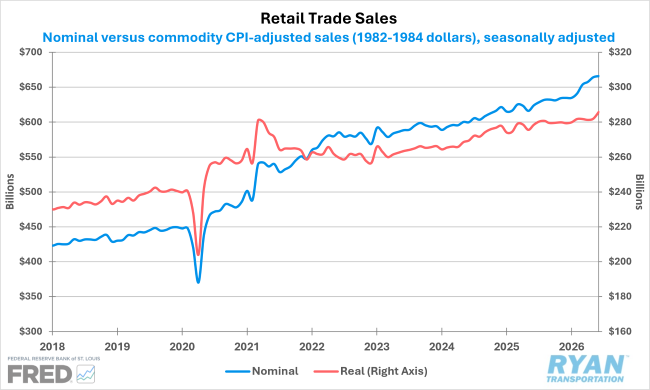
- Retail and food service sales increased slightly by just 0.2% MoM on a seasonally adjusted basis and are up 6.3% YoY, while sales, excluding gasoline station sales, were up 0.7% MoM and 4.8% YoY.
- Excluding food service sales from restaurants and bars, retail trade sales increased 0.2% MoM and were up 6.7% YoY.
Outlook
The outlook for the U.S. economy remains cautiously positive as strong manufacturing activity, healthy consumer spending, AI-related business investment and broad-based freight growth continue to support expansion. Low customer inventory levels, increasing order backlogs and continued investment in industrial and technology infrastructure should sustain production and freight demand throughout the remainder of 2026. However, softening in the labor market, inflationary pressures, tariff uncertainty and ongoing geopolitical risks remain meaningful headwinds that could limit growth. While conditions are likely to remain uneven across sectors, current economic and freight indicators continue to point toward continued expansion rather than a significant slowdown.